Good morning, Friends! Thank you all for coming to worship this morning. I hope you were all able to get some sleep last night during all the fireworks. It’s been a noisy weekend so far!
As you all know, our country is celebrating it’s 250th anniversary this weekend. If you want to get fancy about it, this is our semiquincentennial, or our sestercentennial, or our quarter millennial, or our bicenquinquagenary. Take your pick!
It’s a national holiday. It’s also a special memory for my family. The portrait up front here is my 5th great-grandfather, Jonathan Bass (1773-1790). Jonathan Bass was a colonel in the Minute Men, the militia which fought the British professional army and won at the Battle of Bunker Hill.
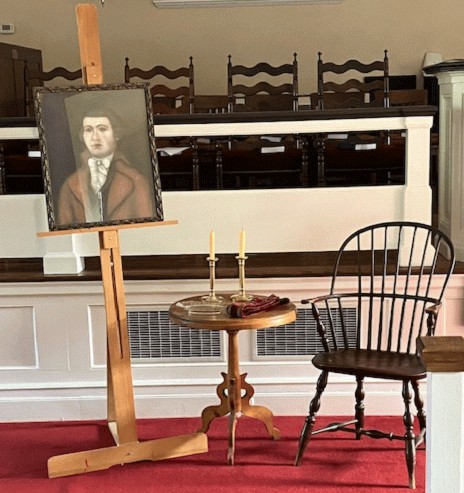
He was 42 years old at the time of Bunker Hill, married with children. There was no time and no money for uniforms at that point, so officers wore a broad sash to identify themselves. On the table, that’s the sash that he wore – it’s been passed down in our family for generations. It kind of brings it home.
I also brought some furniture from the Colonial period, some brass candlesticks which have been giving light to my family for 250 years, and a glass dish that was made a few years later.
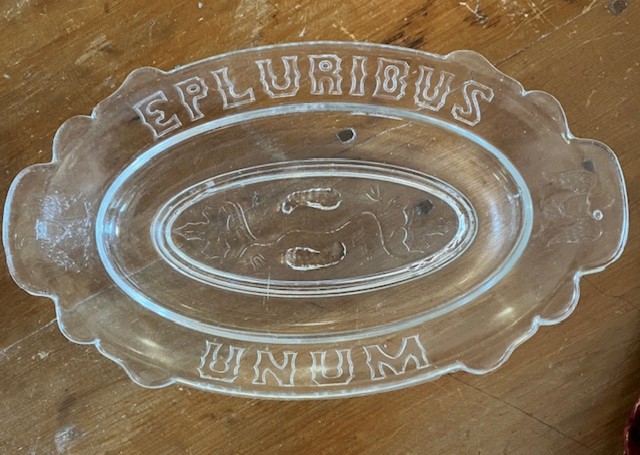
Stamped on the dish is the motto, E Pluribus Unum, which means “Out of many, one”. It was the motto of many people here, 250 years ago. You read it on every United States coin and it’s printed on every one-dollar bill.
It’s a reminder that our nation is diverse, but that we’re meant to be united. The British strategy during the Revolution was “Divide and conquer”. That’s what they tried to do. Remember that. The enemy tried to divide us. The American motto was, “Out of many, one.”
The American Revolution was a huge deal. The British brought in close to 56,000 soldiers during the 8 years of the war. They also brought in 30,000 mercenaries from other countries – the British couldn’t build up their own army fast enough, so they hired professional soldiers from Germany.
The American army enlisted about 80,000 soldiers and militia over the course of the war. They fought in more than 1,500 battles, large and small – at least 29 battles here in North Carolina.
Casualties during the war were high – not just in battle, but from disease. Smallpox, TB and typhoid killed three times as many as died in battle. On the American side, more than eight and a half thousand prisoners of war died in British prisons.
The war spread hardship and disease everywhere it went. Over 100,000 civilians died from smallpox epidemics during the war. When the British lost, over 100,000 people who were loyal to Britain – 4% of the population – left the country, mainly for Canada. Our loss was Canada’s gain.
Some of the things we associate with the 4th of July were way in the future in 1776. The Star-Spangled Banner wasn’t written until 38 years after the Declaration of Independence.
Betsy Ross, a Quaker seamstress in Philadelphia, may have made the first flag, but it wasn’t adopted by Congress till a year later. And the Pledge of Allegiance wasn’t written for 110 years, in 1885., and Congress didn’t adopt the Pledge until 1942.
Many of the things we celebrate and take for granted were no where to be found 250 years ago.
If the United States had lost, the men who signed the Declaration of Independence could have been executed for treason. Just a few months after the Declaration was published, the war was at it’s darkest point. Thomas Paine, who was raised in a Quaker family, wrote: “These are the times that try men’s souls. . .” (The American Crisis)
For our Scripture this morning, I want to read you just one line from the Old Testament, from the book of Leviticus.
Consecrate the fiftieth year and proclaim liberty throughout the land to all its inhabitants. It shall be a jubilee for you; each of you is to return to your family property and to your own clan.
Leviticus 25:10
In the book of Leviticus, God commanded the people of Israel to celebrate a special holiday, every fifty years. The fiftieth year, God said was to be a jubilee. God said to blow a ram’s horn loudly, all through the country, and announce that the year of God’s freedom had arrived.
This verse was engraved on side of the Liberty Bell, which was made for the people of Pennsylvania, the colony started by William Penn.
The Liberty Bell was cast in 1752, and it rang for the Declaration of Independence, 24 years later.
“Proclaim Liberty thro’ all the Land to all the Inhabitants thereof. . .”
That’s what the celebration is all about. Not firecrackers, but freedom. Freedom from tyranny, freedom from wars and kings. Freedom from arbitrary decrees, instead of the rule of law.
A lot of people thought that freedom would come automatically, once the last shot was fired. Turns out, freedom was a long time coming. Every generation, it seems, has to learn what freedom is, what it costs, and what it requires.
In 1776, people were saying, “Why should we let a king we’ve never seen, or a government we never voted for, take all our money and rule our lives?”
250 years ago, they wrote:
“We hold these truths to be self-evident, that all men are created equal, that they are endowed by their Creator with certain unalienable Rights, that among these are Life, Liberty and the pursuit of Happiness.
That to secure these rights, Governments are instituted among Men, deriving their just powers from the consent of the governed, –That whenever any Form of Government becomes destructive of these ends, it is the Right of the People to alter or to abolish it, and to institute new Government, laying its foundation on such principles and organizing its powers in such form, as to them shall seem most likely to effect their Safety and Happiness. . .
. . .When a long train of abuses and usurpations, pursuing invariably the same Object evinces a design to reduce them under absolute Despotism, it is their right, it is their duty, to throw off such Government, and to provide new Guards for their future security.”
They wrote those words, but it took eight years of hard struggle finally to achieve them.
About 12 years after the Declaration of Independence was written – 5 years after the war was over – people realized that freedom still needed some protection. We wrote a new document, a Constitution, creating a true national government.
The Constitution created three branches of government – Congress, the Executive branch, and the courts – and described the responsibilities, powers and limitations of each.
Six years after the Constitution was ratified by all the states, still more protection was needed. To protect our freedom, we passed a group of ten amendments – the Bill of Rights.
The idea of the Bill of Rights is that it protects everyone. No matter who is in Congress, no matter who is elected President, no matter who are the nation’s judges, the Bill of Rights guarantees the same rights to every citizen.
Those rights are so important, because they can’t be taken away from us. And – since this is a Sunday, and this is a sermon, and since this is a Friends meeting – let me point out that many of those rights come directly from the experience of Quakers.
Congress shall make no law respecting an establishment of religion, or prohibiting the free exercise thereof; or abridging the freedom of speech, or of the press; or the right of the people peaceably to assemble, and to petition the Government for a redress of grievances.
The first Amendment is probably the one most closely tied to the Quaker experience. Quakers suffered under the official, established, government-sponsored church. The head of that church was the king of England.
Here in America, several colonies tried to enforce their own version of a government-sponsored church. Here in North Carolina, by law, it was the Episcopal church.
The first Amendment says that Congress can never set up any kind of official church, or stop people from choosing their own religion. The government can’t use tax dollars to support any church. You can believe anything you want to, but you can’t force anyone to obey your religious beliefs, or use your religion to break the law.
Quakers haven’t had much to do with the second Amendment, other than insisting that the military be “well regulated”, and insisting on the right of conscientious objection.
The third amendment says,
No Soldier shall, in time of peace be quartered in any house, without the consent of the Owner, nor in time of war, but in a manner to be prescribed by law.
That was a reaction to one of the most hated practices of the British. The army could come in and take over your house, your barn, your farm animals, anything at all, for it’s own use, without paying for it and without any appeal.
Quakers in particular were hit by both armies during the Revolution, and a group of Quaker leaders in Philadelphia were arrested and held without trial because of our neutrality.
The fourth Amendment says,
The right of the people to be secure in their persons, houses, papers, and effects, against unreasonable searches and seizures, shall not be violated, and no Warrants shall issue, but upon probable cause, supported by Oath or affirmation, and particularly describing the place to be searched, and the persons or things to be seized.
Freedom from arrest, freedom within your home, your papers and possessions, was a freedom which everyone wanted. Quakers had suffered from arbitrary arrest back in England, and again in some parts of America.
No arrest without a warrant. No arrest just because some officer feels like it. No arrest or search unless the officer takes an oath, before a judge, describing exactly who is to be arrested and why, or exactly what premises are to be searched and what they’re looking for. That’s guaranteed by our Constitution.
The fifth, sixth, seventh and eighth Amendments take freedom into the courtroom.
- All serious offenses are examined first by a grand jury. You can’t be charged twice for the same crime.
- You can’t be forced to incriminate yourself.
- You can’t be deprived of life, liberty or property without due process of law.
- The government can’t take your property, without paying you what it’s worth.
- You have a right to a speedy trial, by a local jury.
- You have the right to be told what the charges are against you.
- You have the right to confront any witnesses against you, face to face in court.
- You have the right to compel witnesses to appear in your favor.
- You have the right to have an attorney help you, even if you can’t afford one.
All these things are guaranteed by the Constitution, and in many cases Quakers paid the price for achieving that guarantee.
One right in particular, in the seventh Amendment, says that once a jury has determined the facts of a case, no court, not even the Supreme Court, can change those facts. A judge can decide that there was a mistake in procedure, or that some other right was violated. But the jury, and not the judge, determines what the facts are.
There was a famous case, back in England, where William Penn and another Quaker, were charged with preaching in public, which was against the law in England at that time.
(They would have been protected by the first Amendment if they had lived in America 100 years later!)
The English judge told the jury to find them guilty. The jury found them innocent instead. The judge was furious, and ordered the jury to be locked up, without food or drink or even candles, until they changed and found Penn and the other Quaker guilty.
The jury didn’t give in. And that case led directly, not only to the freedom of religion, but to many of our Constitutional protections against arbitrary arrest, jury intimidation, and the right of the jury to establish the facts.
The last two Amendments say, “If a right isn’t in the Constitution, that doesn’t mean the government or the states can take it away. And if a power or right isn’t specifically given to the U.S. government, or prohibited to any of the states, then that power or right is retained by the people.”
Freedom. That’s what the Constitution is all about. Your freedom, and my freedom. The freedom of everyone who lives in this country. It’s protected. It’s guaranteed. It’s not a privilege. It’s your right.
The American Revolution, the Constitution, and the Bill of Rights, aren’t the end of our freedom, but the beginning. It seems as though every generation has to learn again what freedom is, how we got it, and what it means today.
So, happy 250th birthday! And remember how much the roots of so many of your freedoms, were planted and grown, in Quaker meetings like yours.
“Proclaim Liberty thro’ all the Land to all the Inhabitants thereof. . .”
Let freedom ring!