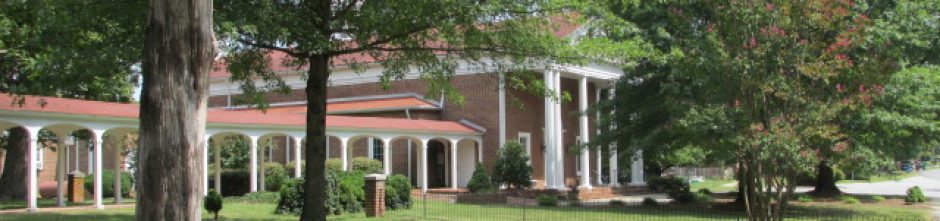
Good morning, Friends! Happy birthday! Today we’re celebrating the 253rd birthday of Springfield Friends.
253 years is a long time. You may not know this, but most churches don’t live this long. Here in America, the average life of a congregation is only 80 to 100 years. They start up, they grow for a little while, and they run out of gas.
That number is true of the tiny little churches you see all across the country. It’s also true of the giant mega-churches that are so popular now. Most congregations in America only live for 80 to 100 years.
So, we’re like Methuselah! We’re like one of those amazing characters in the Old Testament, who lived for hundreds of years.
One of the things that being around as a congregation for more than 250 years does, it gives us perspective. We have witnessed so much. Things have happened all around us.
And one of the gifts that we can offer – to each other, and to the rest of the world – is a sense of time and memory. It’s so important, because God’s time isn’t always our time.
God has been working with us, here in this place, for a long, long time. We have seen so many things. Where other congregations only have short-term memory, we remember things.
Part of why we have Birthday Sunday, and Memorial Sunday, is to pass those memories on, so they’re not lost and forgotten.
Anyway, today we’re going to remember a particular time in the life of our meeting. Something that happened when we were less than 100 years old, something that changed the life of our nation, something which we were direct and personal witnesses of, right here at Springfield.
166 years ago, this very week, the worst war our country has ever seen, finally came to an end. Our country turned away, from making war, to building peace. After four long years, the Civil War was over.
To get started, I want to read from an even older writer, from the prophet Isaiah.
In the last days, the mountain of the Lord’s temple will be established as the highest of the mountains. It will be exalted above the hills, and all nations will stream to it.
Many peoples will come and say, “Come, let us go up to the mountain of the Lord, to the temple of the God of Jacob. He will teach us his ways, so that we may walk in his paths.”
The law will go out from Zion, the word of the Lord from Jerusalem. He will judge between the nations and will settle disputes for many peoples.
They will beat their swords into plowshares and their spears into pruning hooks. Nation will not take up sword against nation, nor will they train for war anymore.
Isaiah 2:2-4
Springfield was an eyewitness to the suffering of the Civil War. This was recorded by a Quaker woman from the area named Mary Mendenhall Hobbs:
“I well remember the anxiety and distress which was everywhere in our part of the land, and how we had become so accustomed to lives of privation and care that it seemed impossible to imagine ourselves released from apprehension and dread.
Many [of our men] had fled from home and had escaped through the lines to prevent being conscripted and forced into the Southern army.
[Other Quaker men] had dwelt in caves and hollow trees and slept in barns and outhouses or crept secretly into their own or the houses of kindly disposed neighbors, never daring to be seen about their premises or attending to any business.
Even if the conscript hunters, who were always roaming about, did not see them, some unfriendly person might report them and they [might] be trapped.
At the close of the war such as had been able to survive returned to find everything impoverished – houses gone, cattle, if any, poor; the merest pretense at farming going on, tools worn out and antiquated, harness mostly ropes, vehicles in the last stages of [falling apart].
The buildings were dilapidated, roofs leaking, windows pasted up with paper or cloth, hinges broken, fences gone – [the fences were] burned up in many cases for wood, in many instances houses and property destroyed by fire.
Eastern Carolina suffered more than we, because the Southern army destroyed as it went, and the Northern army, even after the country had surrendered, in pure wantonness burned buildings for spite.
We learned to do with little and to live on corn bread, which was more easily provided than wheat. We could no more get coffee, sugar or tea than we could get papers from “beyond the lines,” and those who had these articles on hand saved them for sick people.
We drank hot water tea sweetened with sorghum, and made coffee of parched wheat and dried sweet potatoes. We were almost all on the same level and were in what we should now consider very straitened circumstances, but, so far as I remember, [we] were always ready to give each other such aid as was in our power.
Little boys with the assistance of their mothers and sisters had been obliged to do what farm work was done. There were no stores, and nothing to buy goods with if there had been. We were all clothed in homespun cloth, which had the redeeming quality of lasting a long time.
Our shoes were of the coarsest leather, made by a neighborhood cobbler, and we were as delighted with a new pair of these as children nowadays are with the finest.
Our roads are none of the best now, but at the close of the war they were well-nigh impassable. We have many streams and the bridges had almost all gone to wreck or been washed away by “the big freshet”, [a flood] which preceded the close of the war.” [ Mary Mendenhall Hobbs, speaking in the Autobiography of Allen Jay, pp. 172-129]
The Civil War rolled back and forth across the nation for four long years. It was the worst war this country has ever seen. Here in the South, almost 20% of the men – 1 out of 5 – died. Not just in the battles, which were terrible. More than twice as many soldiers died of disease than from wounds. Typhoid fever, malaria, and infections killed more men than bullets ever did. Thirty thousand prisoners of war starved in unspeakable conditions. The Union blockaded the South, deliberately trying to strangle its economy.
During the army campaigns, and especially as General Sherman’s troops marched across Georgia and South Carolina, schools, churches, railroads, towns and farms, were destroyed. Huge parts of the South didn’t recover for more than 60 years.
It all came to an end in a single shattering month, in early April and the first week of May of 1865. If you look at your bulletin, there’s an insert which shows you just how fast it all happened.
On April 2nd, of Petersburg, Virginia fell, after a siege and artillery bombardment that lasted 292 days. Robert E. Lee evacuated his army, and Richmond, the capital of the Confederacy, fell the very next day.
Lee retreated, losing more men every day. A week later, on April 9th, the battle of Appomattox took place. Surrounded and starving, Lee had no choice except to surrender.
Meanwhile, Confederate general Joseph Johnston had been retreating up through Georgia and the Carolinas, pursued by Union General Sherman. On April 13th, General Johnston met in Greensboro with Jefferson Davis, the president of the Confederacy, who was running for his life.
Davis wanted to continue the war. Even though the Union army outnumbered Johnston’s army by 18 to 1, even though the Confederacy had completely lost it’s ability to manufacture arms and recruit more men, Davis believed he could force deserters and old men into the army.
Meanwhile, in Washington, Abraham Lincoln was assassinated. The news was slow to leak out, but when the Union army heard about it, they wanted revenge. Raleigh, North Carolina, was burned to the ground.
On the 15th of April – two weeks after the fall of Richmond, less than a week after Appomattox – Johnston and Sherman met at a farm house near Durham to talk about a surrender. They agreed in principle, but Sherman’s superior, Ulysses S. Grant, rejected the terms. He felt that Sherman was being too soft on Johnston and his army.
Both Johnston and Sherman were considered traitors by their respective governments. Two of Johnston and Sherman’s aides, who were waiting outside the farmhouse, nearly came to blows.
Meanwhile, Johnston’s men were deserting wholesale. His army was melting away, and his headquarters were ransacked by his own men.
Grant and Sherman kept up the pressure. On April 24th, Sherman told Johnston that full hostilities would start again just in 48 hours. On April 26th, Johnston signed the surrender at Durham.
The terms of the surrender were generous:
- All Confederate forces east of the Mississippi were to lay down their arms, and turn them in to the Union.
- All Confederate officers and men had to go before a Union officer, one by one, and sign a statement that they gave their word that they wouldn’t fight again.
- Confederate officers were allowed to keep their swords and pistols, and to take their horses home with them.
- The Union army would immediately provide food for the Confederate army, which was starving.
- All officers and men were allowed to return to their own homes, and would not be disturbed by Union authorities, as long as they kept their word.
The war was over. The surrender was signed at Durham, but Johnston’s army turned in their arms at Greensboro, and the men lined up for the last time in a field at Bush Hill, now Archdale, about a mile away from Springfield.
The clerk of Springfield at that time was a man named Allen U. Tomlinson. He had been a leader of our meeting for more than 40 years. He helped to establish the Sunday School. He helped to start Guilford College.
Allen Tomlinson was an important business man. He ran a large leather factory at Bush Hill. There’s a strong likelihood that his farm was a station on the Underground Railroad. During the Civil War, Allen Tomlinson helped to shield Quaker men from the draft. He worked out an arrangement with the Confederate government, that Quaker men could work in his leather factory and make boots for the Confederate army.
Allen Tomlinson didn’t like making boots for the army. It went against his principles as a Quaker who practiced peace. Many of the leaders of the meeting didn’t like it. It was a compromise, but it kept men from our meeting out of the army, and that was what mattered to him.
Each man had to make a minimum of two pairs of boots a day. Most of the Quaker men had never made boots before. But the experienced men helped teach the new guys, and the experienced men worked late into the night doing more than their share, until the new men learned and caught up with them.
Let me read to you again, from an account of those last few days:
“Just before the surrender of Johnston at Greensboro, one corps of his army was located at Bush Hill. The generals had their headquarters in [Allen Tomlinson’s] home. At night they placed a guard around the house and bolted all the doors. He objected to the guard and unbolted the doors. It appeared later that the wives of the generals were afraid of their own soldiers, as they were poorly fed and had received but little pay and felt that their cause was lost.
But the Friends were preserved and went on with their duties. They held their quarterly meeting as usual, while the army lay around the meeting-house not knowing how soon they might hear the roar of the cannon opening another bloody battle.
But the next day they learned that Johnston and Sherman had tried to negotiate the terms of a surrender, which was soon accomplished, and the poor, weary Confederate soldiers received their small pay, laid down their arms and returned to their sad and, in many cases, destitute homes.” (Autobiography of Allen Jay, p. 125)
The Confederate army abandoned many of its weapons at Bush Hill, and left them lying in the field. Over the years, souvenir hunters found some of them, and a few were eventually brought to the Museum.
On the table in front of you this morning are two very special artifacts from the surrender. I invite you all to come down front today and look at them.The first is a bayonet from a Confederate rifle. The second is a bayonet, which someone took to a blacksmith, who pounded it out, and turned it into a sickle for harvesting grain.
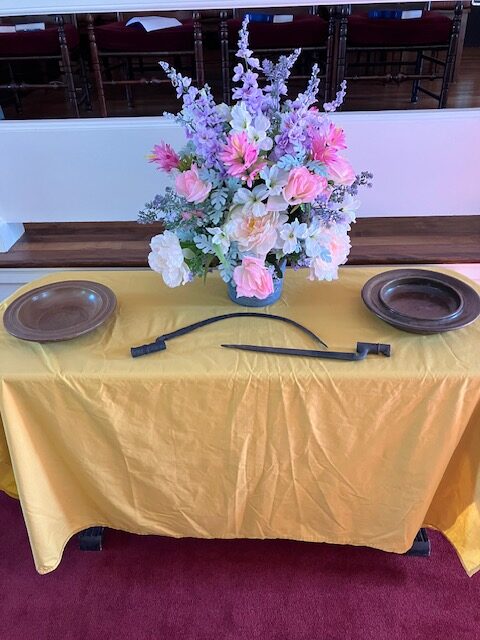
In a very real way, it’s a reminder of today’s Scripture from Isaiah: “They will beat their swords into plowshares and their spears into pruning hooks. Nation will not take up sword against nation, nor will they train for war anymore.”
The most terrible war in all of American history was over, in a shattering climax that stunned the whole nation. And it came to an end right here, at Springfield.